Tiger's back at this week's Accenture Match Play Championship, and so are the ads featuring golf's greatest player. Accenture debuted two new ads, and Nike put together a great ad featuring all five of it's sponsored golf professionals (below).
Of special interest to me, however, is the advertisement being run by the PGA. At this time I have not been able to find the advertisement, but I will keep looking and post it as soon as I can. It features Tiger, in the dressing room, lacing up his shoes while whistling "Eye of the Tiger."
The ad is great because it says exactly what it needs to. Simple white text says "He's back." and fades to the PGA logo and the Accenture Match Play Championship. Everyone recognizes the song, and having Tiger whistle it provides a bit of ironic humor while making the point - he's focused, he's back, and he's ready to play.
But what a lot of people don't know is that the ad is actually a re-framing of a similar ad for the Fed-Ex Cup playoffs several years ago. They just took the raw footage, revised the text, logo, and tournament, and threw it back on the air. Genius on the part of the PGA, since the ad is probably more appropriate now than it was 3 years ago.
Tuesday, February 24, 2009
Eye of the Tiger
Saturday, February 21, 2009
"Late Night" Does it Right
People who know me know that I'm a big fan of Late Night with Conan O'Brien, although I don't get to see the show as much as I'd like because I don't own a TV. Of course, Conan had his last show last night, and taking his place on Late Night will be SNL alum, Jimmy Fallon. He's been going through all the motions that a new host goes through, including one of the most important: choosing a logo for the show. It is crucial that Fallon develop a different identity than Conan, while maintaining the "vibe" of late night. A refresher for those who don't remember Conan's logo:
Conan's logo worked because it was quirky - it reflected his brand of off-beat humor. The strings hanging the nameplate in front of a perspective skewed backdrop of New York was also much different than Leno (although Leno and Conan both had caricatures of their faces associated with the show) or anything on other networks.
So Fallon has big shoes to fill. Fortunately, I think that the Late Show has gotten a good start. Fallon is a lot less outrageous than Conan, and the new logo should reflect that. So, they narrowed it down to three logos:


Of these, I find Logo #1 to be the most compelling. It blends well with the skyline, and the stairstep pattern of the text is really appealing and draws your eye nicely to the name of the host. I think Logo #2 would be serviceable, but not ideal - it makes the name of the host too dominant - this is LATE NIGHT with Jimmy Fallon, not the Jimmy Fallon Show. Part of the reason Conan was so successful was because he had so many great supporting writers and cast. Abe Vigoda, for example.
Logo #3 looks too much like SNL, and while Fallon was on SNL, I think most people remember him from having to yell at him when he cracked up during every skit. Was there a single skit he was in where he didn't laugh the whole time? Besides, Late Night isn't just another SNL. It's nothing like it, and the branding should reflect that.
Watch Jimmy present the logos - the video is especially interesting because there are mockups of how the logos look on coffee cups, which is one of the major exposures that audiences will get.
By the way, the winning logo was #1:
Thursday, February 19, 2009
Pepsi's New Look
Now that the dust has settled from Pepsi's redesign, let's take a look at what they got for the estimated $1.2 Billion it will cost to update their branding.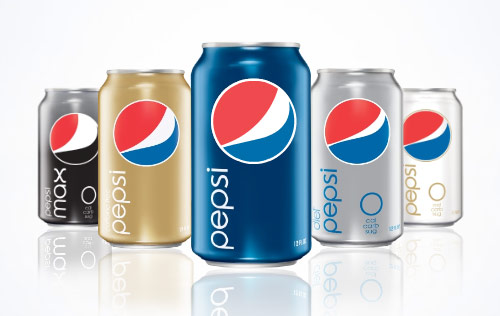
The new design is above. The critical reaction has been mixed: some love the new look, while others think it makes Pepsi look like a generic brand, or the Obama "logo".
I won't go into the technical reasons that I think the logo is a bad move; you can see a really great analysis of it at Before & After. Instead I want to talk about the ROI that isn't going to happen because of the technical details. I encourage you to check out the Before & After link; it is chock full of great details about why the redesign is problematic.
Pepsi is trying to combat the Coca-Cola redesign launched last year. Coke went to a retro, clean, thoroughly planned strategy that conveys the "classic" nature of the brand. It is not retro (although often called that), but rather nostalgic. It maintains everything we know and love about the Coca-Cola package, and loses the extraneous bubbles, ribbons, and gadgets. I will blog about this more tomorrow.
Pepsi's answer was clearly to tell their ad agency (Arnell Group) to come up with a minimalistic, future-retro design. So there were 3 key changes:
1: The all lowercase, sans-serif font.
2: The new "grinning" logo (did you know that the logo was supposed to be smiling?)
3: The solid color cans.
For Pepsi, a company that made "generation next" their slogan, and encouraged drinkers to take the "Pepsi Challenge", one wonders what they gain by going to the simplistic design. It certainly doesn't draw the eye - there's a big empty space with a circle in it, and the word "pepsi" is far too static and bland. It also breaks with all the previous packaging, no matter what Pepsi tells you (video).
In the end though, I think the redesign can be chalked up to the massive ego of the ad agency's director, Peter Arnell. A 27 page PDF proposal for the new brand was leaked online, and it reads like a viral media ploy, or a hoax. The fact that Arnell Group is refusing comment suggests it is not. It is littered with references to the Golden Mean, and compares the attractiveness of the packaging with bends in the space-time continuum. It has to be seen to be believed (and can be seen here).
What was Hulu thinking?
Yesterday Boxee announced that it was removing content from Hulu from it's service. For those unfamiliar with Boxee, it is free media center software that provides connectivity to Hulu, YouTube, CNN, CBS, and downloaded content and plays it directly on your TV. Hulu, an online media portal run by NBC and Fox, was one of the biggest draws for Boxee because Boxee provides an interface for Hulu that makes it easier to use on a TV.
The integration of Boxee and Hulu provided Hulu with nearly 100,000 streams last week - major traffic - and lost of exposure to new audiences. So what was Hulu thinking, removing it's content from Boxee?
First, it wasn't "Hulu" that removed the content, but Hulu's partners (read: NBC and Fox). These networks have a great reason to want to remove the content from Boxee: They don't want you to watch their content on your TV through the internet. They want you to watch it over-the-air. Why? Because over-the-air ads sell for significantly higher rates than online ads do. So they lose money when you watch the show through Boxee and not on your TV.
But somewhere along the line they figured that many people either don't have TV, or don't want it, so NBC and Fox launched Hulu. Hulu is meant to be watched on your computer (according to NBC/Fox), not on your TV. Boxee breaks that barrier down, and makes the networks nervous. What if people start switching from TV to Boxee? What if they speed up the death of network television? These concerns (driven by monetary decision making) are what drove NBC/Fox off of Boxee.
The point? It's temporary. Networks can't keep pretending that the Internet isn't a major provider of content - it is the major provider of content. The sooner that someone pushes full-fledged on-demand TV over IP, the bigger piece of the pie they can control. It seemed that NBC and Fox were forward thinking, new-media savvy juggernauts, but clearly their hands are tied by the old way of thinking.
